
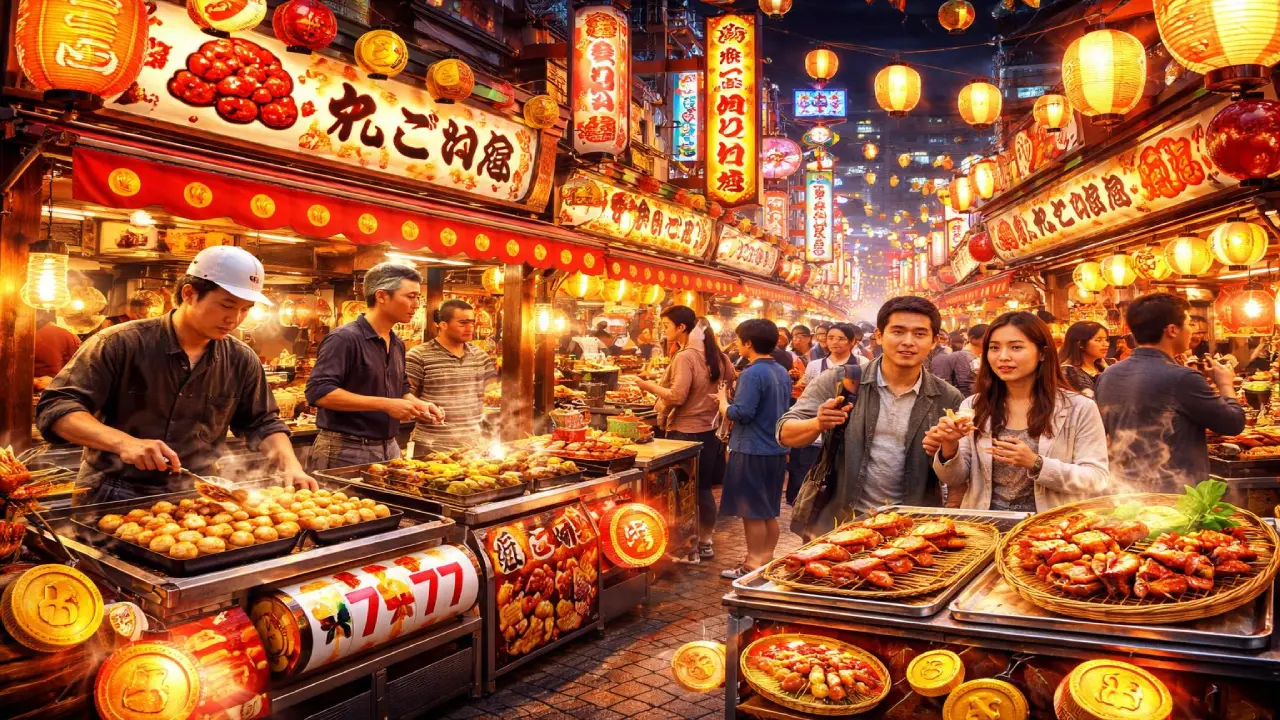
There is a stretch of canal-side street in Osaka called Dotonbori where the air smells like sizzling batter, sweet sauce, and charred octopus at every hour of the day and night. Neon signs tower overhead in every colour imaginable. A giant mechanical crab waves its legs above a restaurant entrance. The iconic Glico Running Man glows against the night sky. Street vendors flip golden takoyaki balls in iron moulds with practiced speed while queues of hungry visitors snake along the pavement. Every sense is engaged simultaneously, and the energy is relentless, joyful, and utterly intoxicating. If you have ever experienced Osaka’s street food scene, you already understand why it makes an extraordinary theme for slot games. And if you have not, this guide will show you exactly why game designers are increasingly turning to the city’s legendary culinary culture for inspiration that goes far beyond chopsticks and cherry blossoms.
The connection between Osaka street food and slot game design runs deeper than surface aesthetics. At its core, Osaka’s food culture embodies the exact emotional qualities that make the best slot games irresistible: sensory overload, anticipation, reward, variety, playful excess, and a joyful refusal to take itself too seriously. The city’s famous philosophy of kuidaore, which translates to “eat until you drop,” is essentially the same attitude that the most successful slot games tap into when they create experiences designed to keep you engaged, entertained, and hungry for one more spin. This article explores every dimension of that connection, from the visual and emotional parallels to the specific game mechanics that Osaka’s food culture naturally inspires.
Kuidaore: The Philosophy That Connects Food and Gaming
To understand why Osaka street food translates so perfectly into slot game design, you need to understand kuidaore. This single word captures an entire philosophy that has defined Osaka’s relationship with food for centuries. It means “eat until you drop” or, in some translations, “eat until you go bankrupt.” It reflects a culture that values indulgence, sensory pleasure, and the unashamed pursuit of enjoyment over restraint, formality, or moderation.
Kuidaore is not about gluttony. It is about enthusiasm. It is about the willingness to explore, to try one more dish, to follow a tempting aroma around a corner without knowing what you will find. It is about valuing the experience of eating as much as the food itself. And it is precisely this spirit that makes the best slot games compelling. A great slot game does not just offer you a chance to win money. It offers you an experience that makes you want to keep playing because the act of spinning is itself enjoyable, visually stimulating, and emotionally engaging.
Osaka’s food culture has always been democratic and accessible. Unlike the refined kaiseki cuisine of neighbouring Kyoto, which emphasises presentation and restraint, Osaka street food is hearty, unpretentious, and designed to be enjoyed by everyone regardless of status or budget. Most dishes cost between 300 and 700 yen, making it possible to sample a wide variety without overspending. This accessibility mirrors the appeal of slot games, which offer entertainment at virtually every budget level, from micro-stakes players spinning for a few rupees to high rollers wagering on premium titles.
| Kuidaore Principle | How It Manifests in Osaka Food Culture | How It Translates to Slot Game Design |
|---|---|---|
| Sensory indulgence | Rich flavours, sizzling sounds, aromatic streets | Vibrant visuals, dynamic soundscapes, animated wins |
| Joyful excess | Eat until you drop, try everything available | Bonus features that cascade, multiply, and escalate |
| Accessibility | Affordable dishes for every budget and taste | Wide betting ranges from micro-stakes to high roller |
| Variety and exploration | Dozens of dishes to discover across every street | Multiple bonus mechanics and game features to unlock |
| Social experience | Eating together at communal counters and stalls | Multiplayer features, leaderboards, shared jackpots |
| Anticipation and reward | Watching your takoyaki cook before the first bite | Building tension before bonus reveals and big wins |
| Playful presentation | Giant neon signs, animated mascots, theatrical cooking | Character-driven games, animated symbols, playful themes |
The Visual Feast: Why Osaka Street Food Is a Designer’s Dream
From a pure design perspective, Osaka street food offers an embarrassment of visual riches that translate beautifully to the slot game screen. Every iconic dish has a distinctive, instantly recognisable visual identity that works as a game symbol. Every street food district has an atmospheric palette, a combination of colours, lighting, textures, and energy, that can define an entire game’s aesthetic. And every element of the street food experience, from the cooking process to the presentation to the act of eating, provides animation opportunities that bring reels to life in ways that generic fruit or gem symbols simply cannot match.
Takoyaki, the golden spherical octopus balls that are Osaka’s most iconic street food, are visually perfect for slot game design. Their round shape naturally fits symbol frames. Their golden-brown colour with drizzled sauce, dancing bonito flakes, and sprinkled green onions provides rich visual detail at any resolution. The cooking process, with batter being poured into hemispheric moulds and deftly flipped with picks, offers dynamic animation potential for bonus features and transitions.
Okonomiyaki, the thick savoury pancake that is Osaka’s second most famous dish, provides equally compelling visual material. The sizzling griddle, the dramatic drizzle of sauce in cross-hatch patterns, the cascade of bonito flakes that dance in the rising heat as if alive, and the final presentation with its layers of colour and texture all create animation moments that slot designers can use to punctuate wins, trigger bonuses, and build atmosphere.
Dotonbori itself is a visual theme that practically designs its own game. The neon-drenched streetscape, the canal reflections, the oversized food signs, the bustling crowds, and the theatrical cooking performances happening at every stall create a backdrop that is visually richer and more dynamic than almost any other urban environment on earth. A slot game set in Dotonbori would have an automatic visual advantage over competitors simply because the source material is so extraordinarily vibrant.
| Osaka Street Food | Visual Characteristics | Slot Game Design Potential |
|---|---|---|
| Takoyaki (octopus balls) | Golden spheres with sauce, bonito flakes, green onion | Perfect round symbol shape with rich animation detail |
| Okonomiyaki (savoury pancake) | Sizzling griddle, sauce patterns, dancing bonito flakes | Dynamic cooking animation for bonus triggers |
| Kushikatsu (deep-fried skewers) | Golden battered skewers with variety of fillings | Collectible symbol mechanic, each skewer reveals different prize |
| Taiyaki (fish-shaped cake) | Adorable fish-shaped pastry with sweet filling | Character symbol with wide appeal and cute factor |
| Ikayaki (grilled squid) | Charred squid with glossy soy glaze | Sizzling reel animation with smoke and steam effects |
| Dotonbori neon signs | Giant crab, Glico Running Man, colourful signage | Background animation and ambient atmosphere |
| Ramen bowls | Steaming broth, noodles, toppings arrangement | Fill-the-bowl bonus mechanic collecting toppings |
| Matcha desserts | Vivid green colour with elegant presentation | Scatter symbol with distinctive colour recognition |
Game Mechanics Inspired by Osaka Food Culture
Beyond visuals, Osaka street food culture naturally suggests game mechanics that are both intuitive and engaging. The best slot mechanics feel organic rather than arbitrary, as if the game’s features grew naturally from its theme rather than being bolted on after the fact. Osaka food culture provides a rich foundation for mechanics that feel this way because the rituals and rhythms of street food eating map remarkably well onto the structures of modern slot gameplay.
The cooking process itself suggests a progressive bonus mechanic. Imagine a takoyaki bonus feature where empty moulds appear on screen and batter is poured in one by one. Each filled mould reveals a multiplier or prize value when the ball is flipped. The more moulds you fill before the bonus ends, the bigger your total prize. This mechanic mirrors the real experience of watching takoyaki being prepared, where anticipation builds as each ball takes shape and the final tray reveals the complete set.
The kuidaore philosophy of trying everything available maps perfectly onto a collection mechanic where players accumulate different Osaka dishes across multiple spins. Each new dish added to the collection unlocks a progressively larger reward, encouraging continued play and creating a sense of progression that mirrors the experience of eating your way through a Dotonbori food crawl. When the complete collection is assembled, a mega bonus triggers, delivering the full kuidaore experience in digital form.
Kushikatsu, the deep-fried skewers served at standing counters across Osaka, suggests an elegant pick-and-click bonus where players choose skewers from a selection, each hiding a different prize. The famous Osaka rule of no double-dipping adds a natural constraint: once you pick a skewer, you cannot go back for another dip, creating genuine decision-making tension within a simple mechanic.
| Food Experience | Inspired Game Mechanic | How It Would Work in a Slot |
|---|---|---|
| Watching takoyaki cook | Progressive fill bonus | Fill moulds one by one, each reveals multiplier prize |
| Dotonbori food crawl | Collection and trail mechanic | Collect dishes across spins, complete set triggers mega bonus |
| Kushikatsu no double-dipping rule | Pick-and-click with commitment | Choose skewers with hidden prizes, no changing your mind |
| Okonomiyaki customisation | Player choice bonus | Select toppings that modify multiplier or feature type |
| Queuing at a popular stall | Anticipation meter | Meter fills during base game, triggers bonus when full |
| Chef flipping takoyaki | Skill-based mini-game | Time your tap to flip perfectly for maximum prize |
| Ramen topping selection | Stacking bonus feature | Each topping adds a layer to the bonus multiplier |
| Festival food stall hopping | Free spins with roaming wild | Wild symbol moves between stalls on each spin |
The Emotional Connection: Why Food Themes Outperform Generic Designs
Food themed slot games consistently perform well across global markets because food triggers universal emotional responses that transcend cultural boundaries. Everyone understands the pleasure of a delicious meal, the anticipation of a dish being prepared, and the satisfaction of the first bite. These emotions are hardwired into human experience, and when a slot game successfully evokes them through visual design, animation, and sound, it creates an emotional connection that abstract themes like gems, numbers, or generic mythology cannot match.
Osaka street food takes this emotional connection to another level because it is not just about the food itself. It is about the entire experience that surrounds it. The theatre of the cooking. The social energy of eating alongside strangers at a communal counter. The sensory immersion of a street filled with competing aromas, sizzling sounds, and shouted greetings from vendors. The adventure of discovering a hidden stall in a back alley that serves the best takoyaki you have ever tasted. These experiential layers give a slot designer far more emotional material to work with than a simple image of food on a plate.
For players in India and across Asia, the connection to street food culture is particularly resonant. Indian players understand instinctively what kuidaore means because India has its own magnificent street food tradition, from the chaat stalls of Delhi to the dosa stands of Chennai to the vada pav vendors of Mumbai. The experience of navigating a vibrant street food market, choosing from an overwhelming array of options, and surrendering to the sensory overload of a food district is universal across Asian cultures. A slot game that captures this energy speaks to Indian players on a deeply familiar emotional level, even when the specific dishes are Japanese rather than Indian.
| Emotional Trigger | How Osaka Food Creates It | How a Slot Game Can Replicate It |
|---|---|---|
| Anticipation | Watching food cook on the griddle in front of you | Building bonus meters and progressive reveal features |
| Satisfaction | The first bite of perfectly cooked takoyaki | Winning combination animations with sizzle and steam effects |
| Discovery | Finding a hidden gem stall down a side street | Random bonus triggers and surprise features |
| Comfort | Warm ramen on a cold evening | Cosy visual atmosphere with ambient street sounds |
| Excitement | The energy of a crowded Dotonbori at night | High-energy neon visuals with dynamic soundtrack |
| Nostalgia | Returning to a favourite childhood street food | Familiar food symbols that trigger warm associations |
| Social belonging | Sharing a meal at a communal counter | Multiplayer elements and shared bonus celebrations |
Existing Food and Japanese Themed Slots That Prove the Concept
The gaming industry has already demonstrated that both food themes and Japanese cultural themes perform exceptionally well in the slot market. Titles celebrating Asian cuisine, such as Running Sushi by Pragmatic Play, use food imagery as the primary visual language and have attracted dedicated player bases. Japanese themed slots like Moon Princess, Sakura Fortune, and Matsuri have proven that Japanese cultural content resonates powerfully with global audiences. The intersection of these two proven categories, an Osaka street food themed slot, represents an untapped opportunity that combines the emotional appeal of food with the visual richness of Japanese culture.
What makes the Osaka street food concept particularly compelling is that it avoids the over-familiar tropes that dominate the Japanese slot category. Samurai warriors, cherry blossoms, and geisha characters are beautiful and effective, but they have been done many times by many providers. An Osaka street food theme offers something genuinely fresh: a vibrant, contemporary, urban Japanese setting that feels alive and modern rather than historical or mythological. It brings the excitement of a real place that millions of people visit and love every year into a format that can reach players everywhere in the world.
The design potential extends beyond a single game. An entire series of Osaka food-themed slots could be developed, each focusing on a different district, dish, or aspect of the kuidaore culture. A Dotonbori neon-themed game. A Kuromon Market morning-fresh seafood game. A late-night ramen stall game with a completely different mood and pace. A festival food game tied to seasonal events. The thematic depth of Osaka’s food culture is vast enough to support an entire franchise of games, each with its own personality and mechanical identity.
| Game Concept | Setting | Signature Mechanic | Mood and Atmosphere |
|---|---|---|---|
| Dotonbori Nights | Neon-lit canal-side strip | Cascading reels with neon wild explosions | High energy, electric, urban nightlife |
| Takoyaki Master | Traditional street stall | Progressive mould-filling bonus with multipliers | Warm, theatrical, focused on craftsmanship |
| Kuromon Market | Historic covered market | Collection mechanic gathering fresh ingredients | Morning freshness, authentic, discovery-focused |
| Ramen Midnight | Late-night ramen counter | Topping stacker bonus building multiplier layers | Cosy, intimate, slow-burning anticipation |
| Kuidaore Festival | Matsuri food stall alley | Free spins with roaming food vendor wilds | Festive, colourful, celebratory excitement |
| Kushikatsu Gamble | Standing counter bar | Pick-and-commit skewer selection bonus | Social, bold, risk-reward tension |
| Osaka Sweet Street | Dessert and taiyaki district | Cascading sweets with sugar rush multiplier chain | Playful, cute, lighthearted fun |
Sound Design: The Unsung Hero of an Osaka Food Slot
Visual design gets most of the attention in slot game analysis, but sound design is equally important in creating an immersive experience, and Osaka street food culture provides an exceptionally rich audio palette. The sounds of an Osaka food district are distinctive, layered, and emotionally evocative in ways that a skilled sound designer can translate directly into a gaming soundtrack.
The sizzle of batter hitting a hot griddle. The rhythmic tapping of takoyaki picks against iron moulds. The bubbling of deep-frying oil. The scraping of a metal spatula across a teppan grill. The cheerful shouts of vendors calling customers to their stalls. The ambient hum of a crowd navigating narrow food alleys. The clink of beer glasses at a standing counter. Each of these sounds carries emotional information that tells the player they are in a specific, real, vibrant place rather than a generic digital environment.
A well-designed Osaka street food slot would use these sounds to punctuate gameplay moments. The sizzle could accompany a wild symbol landing. The vendor shout could signal a bonus trigger. The crowd hum could build during free spins as anticipation rises. The satisfying crunch of a first bite could celebrate a winning combination. When audio and visual design work together to create a cohesive sensory experience, the result is a game that feels genuinely immersive rather than merely decorative.