
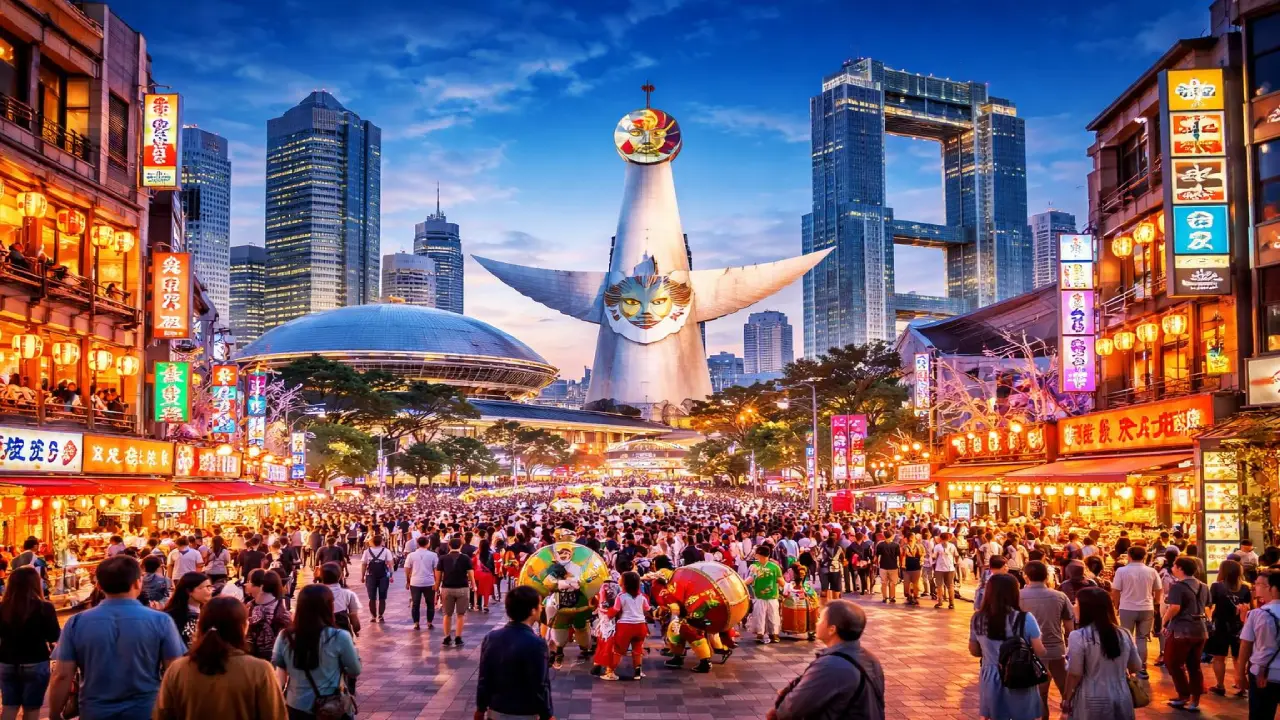
In the spring of 1970, an 815-acre stretch of hills in Suita, just outside Osaka, became the stage for the most ambitious spectacle Japan had ever produced. The Japan World Exposition, known simply as Expo 70, drew an astonishing 64 million visitors over six months, a record that stood as the highest attendance for any world fair until the Shanghai Expo surpassed it four decades later. Seventy-seven countries participated, showcasing their visions of the future beneath futuristic pavilions designed by some of the most brilliant architectural minds of the twentieth century. At the centre of it all stood Taro Okamoto’s Tower of the Sun, a 70-metre sculpture with three faces symbolising the past, present, and future, an icon that remains Osaka’s most recognisable cultural landmark more than half a century later.
But Expo 70 was far more than a six-month exhibition. It was a defining moment that permanently altered how Osaka saw itself and how the world saw Osaka. The event transformed the city from a respected commercial centre into a global destination for innovation, spectacle, and entertainment. The DNA of that transformation runs through everything Osaka has built since, from its theme parks and entertainment districts to its festival culture, its gaming industry, and the $8.9 billion integrated casino resort now rising on Yumeshima Island. Understanding the legacy of Expo 70 is understanding why Osaka has become one of the most dynamic entertainment cities in Asia and why its influence continues to shape experiences that millions of people enjoy today.
What Made Expo 70 So Revolutionary
To appreciate the legacy, you first need to understand just how groundbreaking Expo 70 was in its moment. Japan in 1970 was a nation in the midst of an extraordinary economic miracle, and the Expo was conceived as a declaration to the world that Japan had not merely recovered from the devastation of war but had leapt to the forefront of global innovation. The theme, “Progress and Harmony for Mankind,” captured both the ambition and the idealism of the era.
The fairground was a landscape of glittering laser beams, clicking computers, and clanking robots that demonstrated the outer edge of what technology could achieve. The NTT pavilion showcased prototype cordless phones that foreshadowed the mobile communication revolution. The Fuji pavilion premiered the world’s first IMAX film, immersing audiences in a cinematic experience that felt genuinely revolutionary. The United States pavilion displayed a moon rock from Apollo 12, fresh from humanity’s triumph on the lunar surface. Moving walkways whisked visitors across the enormous site, and computer-controlled entertainment systems created interactive experiences that were decades ahead of their time.
The architecture was equally radical. Designed by legendary architect Kenzo Tange and assisted by a team that included future icons like Arata Isozaki and Kisho Kurokawa, the Expo’s structures looked as though they had leapt from the pages of science fiction. The Metabolist movement, which envisioned buildings as living organisms that could grow and adapt, found its most spectacular expression in the Expo’s pavilions. Kurokawa’s Takara Beautillion and Capsule House presented modular living units that could be plugged into larger infrastructural frames, a concept later realised in Tokyo’s iconic Nakagin Capsule Tower.
| Expo 70 Innovation | What It Introduced | Long-Term Impact |
|---|---|---|
| IMAX cinema (Fuji Pavilion) | First large-format immersive film experience | Launched the global IMAX industry and immersive cinema |
| Cordless telephone prototype | Early demonstration of wireless mobile communication | Foreshadowed the smartphone revolution |
| Moving walkways | Automated pedestrian transport across the site | Standard feature in airports and entertainment complexes worldwide |
| Computer-controlled entertainment | Interactive exhibits responsive to visitor behaviour | Foundation of modern interactive entertainment design |
| Metabolist architecture | Buildings designed as adaptable, growing organisms | Influenced decades of experimental architecture globally |
| Laser and holographic displays | Cutting-edge optical technology for public entertainment | Paved the way for laser shows and holographic entertainment |
| Moon rock display (US Pavilion) | Physical artifact from Apollo 12 lunar mission | Demonstrated the power of experiential exhibition design |
| Tower of the Sun | 70-metre sculptural icon by Taro Okamoto | Became Osaka’s permanent cultural symbol |
How the Expo Transformed Osaka’s Physical Landscape
The most immediate and tangible legacy of Expo 70 is inscribed in Osaka’s physical infrastructure. The massive investment required to host the world’s fair did not disappear when the pavilions came down. Instead, it left behind transportation networks, public spaces, and development patterns that continue to shape the city more than five decades later.
The Expo site itself became the 260-hectare Expo Commemorative Park, one of the largest urban parks in the Kansai region. The park preserves key elements of the original Expo, including the Tower of the Sun, the Japanese Garden, and the Japan Folk Crafts Museum, while also housing the National Museum of Ethnology, one of Japan’s most important academic institutions. The park has become a beloved green space that serves both as a living memorial to 1970 and as a thriving recreational destination for residents across the region.
More recently, the area immediately outside the park’s main gate has been developed into Expocity, a massive shopping and entertainment complex that includes over 300 stores, Japan’s largest Ferris wheel, a cinema, and the innovative Nifrel aquarium featuring barrier-free displays where animals and humans can interact. The evolution from world fair site to commemorative park to modern entertainment hub illustrates how Expo 70’s legacy has continued to generate new forms of engagement at the same location across three distinct eras.
The transportation infrastructure built for the Expo, including new rail lines, highway connections, and the Osaka Monorail, opened up areas of the city that had previously been difficult to access. This improved connectivity did not just serve the Expo. It permanently expanded Osaka’s development potential and made it possible for entertainment, commercial, and residential zones to flourish in areas that would have remained peripheral without the catalyst of the world fair.
The Birth of Osaka as an Entertainment Capital
Before Expo 70, Osaka was known primarily as Japan’s commercial capital, the “Kitchen of Japan” famous for its merchant culture, its food, and its pragmatic business sensibility. The Expo added a new dimension to this identity by demonstrating that Osaka could also be a world-class destination for spectacle, innovation, and entertainment on a scale that rivalled anything produced by any city on earth.
This shift in identity had profound long-term consequences. The confidence and infrastructure generated by the Expo created the conditions for Osaka to attract major entertainment investments in the decades that followed. Universal Studios Japan, which opened in 2001 in the Konohana Ward and has become one of the most visited theme parks in Asia, chose Osaka in part because the city had already established itself as a destination where large-scale entertainment could thrive. The connection to Expo 70 is not just symbolic. It is practical: the city had proven it could manage massive visitor numbers, deliver world-class experiences, and sustain public interest in ambitious entertainment projects.
The Dotonbori and Shinsekai entertainment districts, while predating the Expo, experienced a renaissance in the post-Expo decades as Osaka leaned into its emerging identity as a city of fun, food, and sensory indulgence. The city’s famous philosophy of “kuidaore,” eating until you drop, expanded into a broader cultural identity that embraced entertainment excess in all its forms. Today, Osaka’s Kita and Minami entertainment districts are always bustling with visitors from around the world, and the city was selected by The New York Times as one of the top destinations to visit, standing shoulder to shoulder with Tokyo as a leading international tourist destination.
| Osaka Entertainment Milestone | Year | Connection to Expo 70 Legacy |
|---|---|---|
| Expo 70 World Fair | 1970 | Established Osaka as a global destination for spectacle and innovation |
| Expo Commemorative Park opens | 1972 | Preserved the Expo site as a permanent cultural and recreational space |
| Universal Studios Japan opens | 2001 | Built on Osaka’s proven capacity for large-scale entertainment |
| Expocity entertainment complex opens | 2015 | Revitalised the original Expo site with modern retail and entertainment |
| Expo 2025 on Yumeshima Island | 2025 | Renewed Osaka’s Expo tradition with 150 participating nations |
| MGM Osaka Integrated Resort (planned) | 2030 | $8.9 billion casino resort on the same island as Expo 2025 |
| Yumeshima redevelopment plans | 2030 and beyond | Water park, potential F1 circuit, and entertainment district |
Expo 70’s Influence on Japanese Gaming and Entertainment Design
The design philosophy that defined Expo 70, the idea that technology and art should combine to create immersive, multi-sensory experiences that engage visitors as participants rather than passive observers, has become the foundational principle of Japanese entertainment design. This philosophy runs through everything from Tokyo’s teamLab installations to the pachinko parlours that dot every Japanese city to the online gaming platforms that serve millions of players worldwide.
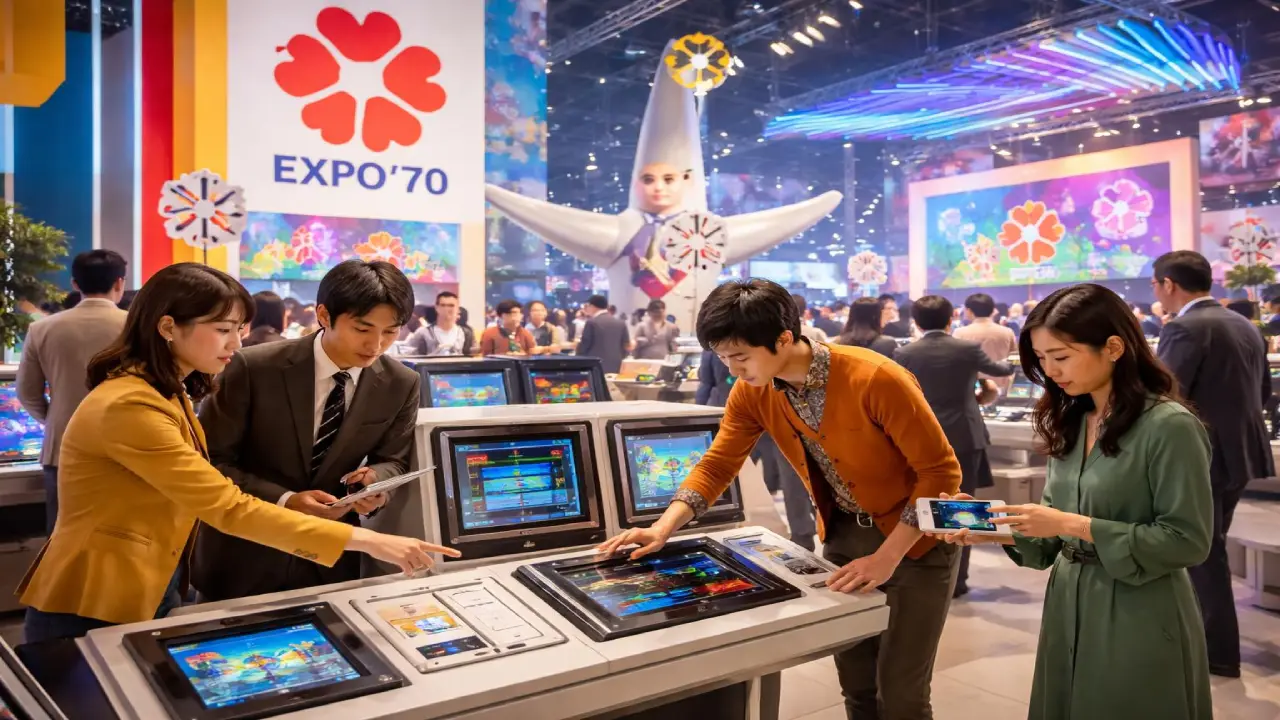
Expo 70 pioneered the concept of computer-controlled entertainment, where exhibits responded to visitor behaviour and created personalised experiences in real time. This was revolutionary in 1970, and it established a design tradition that Japanese companies have been refining ever since. The interactive arcade games that emerged in Japan during the 1970s and 1980s, the immersive theme park rides that Japanese designers became famous for, and the responsive digital gaming experiences that define the modern online casino industry all trace their conceptual lineage back to the same principle: use technology to make the audience feel like they are inside the experience rather than watching it from the outside.
The visual spectacle of the Expo, with its laser displays, holographic projections, and architecturally impossible structures, established an aesthetic ambition that permeates Japanese entertainment to this day. When you play a visually stunning Japanese themed slot game with cascading cherry blossoms and samurai animations, or when you sit at a live dealer table in a studio designed to evoke the elegance of a traditional Japanese interior, you are experiencing design values that were crystallised and broadcast to the world at Expo 70.
| Expo 70 Design Principle | How It Appeared at the Expo | How It Appears in Modern Entertainment |
|---|---|---|
| Technology as art | Laser shows and holographic displays as pavilion centrepieces | LED spectacles, projection mapping, and immersive installations |
| Interactive participation | Computer-controlled exhibits responding to visitor input | Personalised gaming experiences and adaptive AI platforms |
| Architectural immersion | Pavilions designed to envelop visitors in themed environments | Themed casino resorts and experience-driven entertainment venues |
| Multi-sensory engagement | Sound, light, movement, and tactile elements combined | Surround sound gaming, haptic feedback, and VR entertainment |
| Futurism as spectacle | Showcasing technology that felt decades ahead of its time | Cutting-edge game mechanics and next-generation platform design |
| Cultural storytelling through design | Japanese identity expressed through avant-garde architecture | Japanese themed games, culturally immersive digital experiences |
From Expo 70 to Expo 2025 to the MGM Osaka Resort
The thread connecting Expo 70 to Osaka’s future entertainment ambitions is not just philosophical. It is literally geographical. The MGM Osaka Integrated Resort, Japan’s first casino resort, is being built on Yumeshima Island in Osaka Bay, the same artificial island that hosted Expo 2025 with over 150 participating nations. When the $8.9 billion resort opens around autumn 2030, it will feature a 27-storey tower housing two hotels with approximately 1,840 rooms, a casino with 470 table games and 6,400 electronic gaming machines, a theatre, and a massive convention and exhibition complex spanning 16.7 hectares.
The resort’s design philosophy explicitly draws from the Expo tradition of blending Japanese cultural identity with cutting-edge international entertainment. The development will include the MUSUBI Hotel with specialised studios for traditional Japanese activities such as tea ceremonies, tourist attractions inspired by Japanese culture, and architectural design that transitions between high-energy gaming zones and tranquil hospitality spaces. This approach, combining cultural depth with entertainment spectacle, is a direct evolution of the design principles that made Expo 70 so influential.
The broader Yumeshima redevelopment plan envisions transforming the island into a comprehensive entertainment district that could include a water park, a potential Formula One-oriented racing circuit, and complementary leisure facilities. Osaka’s stated target of 30 million annual visitors positions the city in direct competition with Las Vegas and Singapore as a global entertainment destination, but with a distinctive advantage that neither rival can replicate: a cultural identity forged through more than a thousand years of festival tradition and refined through the Expo legacy into a uniquely Japanese approach to spectacle and experience design.
| Yumeshima Development | Details | Expected Impact |
|---|---|---|
| MGM Osaka Integrated Resort | 470 tables, 6,400 gaming machines, 1,840 hotel rooms, theatre | Japan’s first casino resort, targeting international tourism |
| Convention and exhibition complex | 16.7 hectares across four storeys | Major MICE destination for global business events |
| Potential water park | Large-scale aquatic entertainment facility | Family and leisure tourism attraction |
| Possible F1 racing circuit | Motorsport-oriented track and facilities | Unique sporting entertainment asset competing with global venues |
| Cultural attractions | Tea ceremony studios, Japanese art and performance spaces | Cultural immersion integrated into entertainment experience |
| Transportation upgrades | Enhanced rail and road connections to Yumeshima | Improved visitor access and capacity for 30 million annual target |
Why Expo 70’s Legacy Matters for the Future of Entertainment
The story of Expo 70 is ultimately a story about how a single event can reshape the identity of a city and influence the design of experiences that billions of people enjoy decades later. The principles established at the Expo, that entertainment should be immersive rather than passive, that technology and art are most powerful when combined, that cultural identity enhances rather than limits universal appeal, and that spectacle should serve human connection rather than replace it, have become the guiding values of the world’s most successful entertainment enterprises.
For anyone interested in the entertainment industry, whether as a player, a designer, a business professional, or simply a curious observer, understanding the Expo 70 legacy provides essential context for why modern entertainment looks, feels, and functions the way it does. The interactive gaming platforms you use today, the themed resort experiences you dream of visiting, and the culturally immersive digital entertainment you enjoy on your smartphone all carry traces of what happened on those 815 acres of Osaka hillside more than half a century ago.
Osaka’s journey from commercial capital to entertainment powerhouse was not accidental. It was catalysed by a single, audacious event that showed the city and the world what was possible when ambition, creativity, technology, and cultural pride converge in one place at one moment. Expo 70 provided that spark, and everything Osaka has built since, from Universal Studios Japan to Expocity to the festivals that fill its streets with millions of celebrants every year to the integrated resort rising on Yumeshima Island, is part of the same ongoing story.
That story is far from over. As Osaka positions itself alongside Las Vegas and Singapore in the global entertainment race, it carries an advantage that no amount of investment can purchase: a cultural identity shaped by a thousand years of festival tradition, refined by the transformative ambition of Expo 70, and now evolving into something entirely new. The city that showed the world its first IMAX film, its first cordless phone, and its first vision of modular architecture is preparing to show the world something extraordinary once again. And if history is any guide, the experience will be worth the wait.